

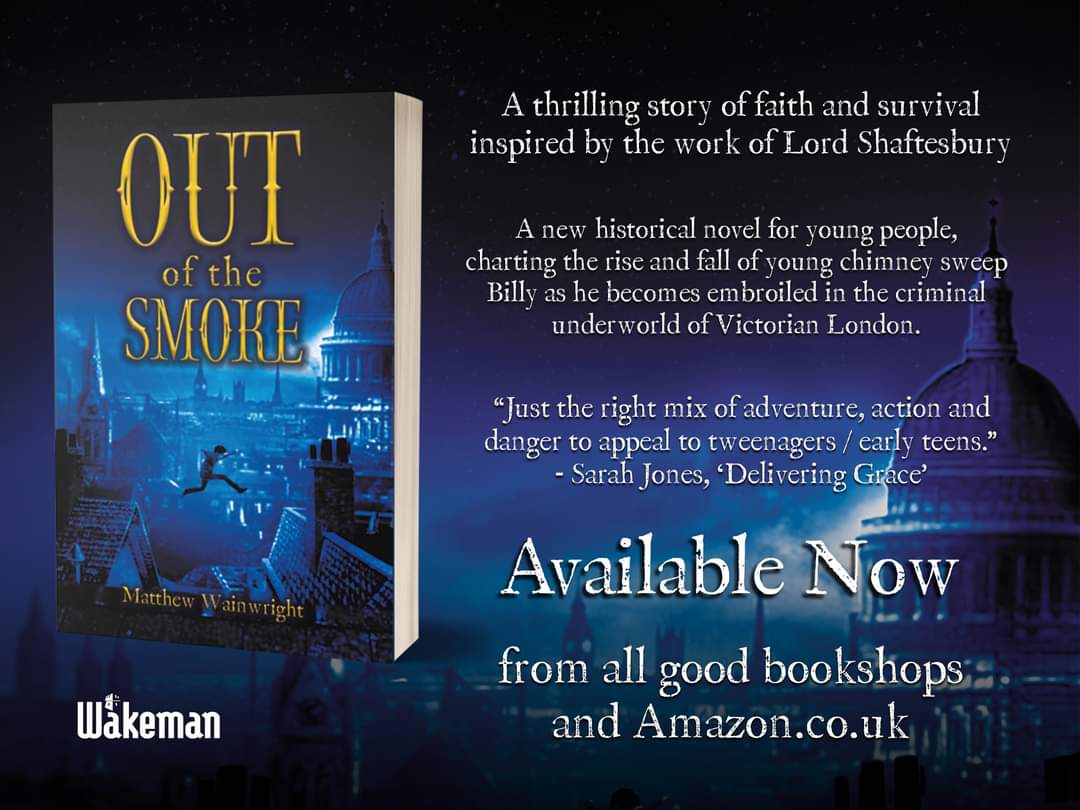
An ‘Out of the Smoke’ Short Story
Part 3
Once the group was safely back in the dim warmth of the kitchen, Daniel turned to Clara and held out a hand.
“Give it here, young lady,” he growled.
Clara hesitated, then with a scowl she took out the pen-knife and dropped it into Daniel’s outstretched palm.
“I won’t stand thievery,” Daniel said. “I’ll think of a suitable punishment for you in the morning. Go on now. Off to bed, all of you.”
He dismissed the group with a curt wave and Robert sank onto a nearby chair, his legs trembling. He had been holding himself together, but now a cold wave of fear washed through him as he thought of what could have happened. In his mind’s eye he saw the knife appear in the boy’s hand, his expression changing in an instant from playful to threatening. It would have meant nothing to him—to any of them—to have harmed Clara, Tosher or himself. He shuddered to think how close he had come.
“Here.” Daniel handed him a mug of hot, dark tea. “Get that down yer.”
Robert took the tea gratefully and sipped at it as Daniel sat down opposite and took out his pipe.
“Close call,” he observed, filling the bowl and lighting it. He took a few puffs and blew out a wreath of smoke. “I expect yer thinkin’ about what ‘appened. What yer could’ve done different. Well let me tell yer what yer could’ve done: nuffin. That Ned Dawson’s a wrong ‘un—always has been—and no matter what any of yer said or did, ‘e would’ve got ‘is back up. Would’ve made a reason, if ‘e ‘adn’t been given one. That’s what lads like ‘im does: they goes out with a great big chip on their shoulder, ready to show all the world they ain’t afraid of no-one and nuffin’. And the way they do it’s by persecutin’ honest folk who never done ‘em no ‘arm. A bully, is what ‘e is. Plain and simple.”
“Still,” Robert said. “That doesn’t change the fact that I was a coward, Daniel. I could have stepped forward, confronted them, done something. But I didn’t do anything. I just … froze.”
Daniel sighed, and turned his gaze upwards to the ceiling. The fire in the grate crackled and spat, and Robert waited.
“We’re not alike, you and I,” Daniel said at last. “I were born round ‘ere. I grew up with lads just like Ned. I learned ‘ow ter speak to ‘em, ‘ow ter ‘andle ‘em. ‘Ad me fair share of trouble, in me younger days. There’s more to it than what you do or don’t do, what you say or don’t say—it’s in the way you stand, the way you look, the way you ‘old yer ‘ands. Lads like Ned, they can tell who grew up on the street and who didn’t. I’d ‘oped that bringin’ you out on nights like tonight would ‘elp you learn a bit o’ that—’elp you learn about these people, the lives they live, what matters to ‘em. And maybe you ‘ave. But you ain’t one of ‘em, Robert. You ain’t one of us. And there’s some things yer better off not knowin’, and not bein’ a part of.”
“But the Earl—” Robert began, before Daniel cut him off with a dismissive wave.
“Oh, the Earl’s different,” he said. “You can’t compare yerself to ‘im. It’s like … like there’s a ladder, and we’re all sittin’ on it, right? The folks you met today are sittin’ on the bottom rungs, and you and I are a little ‘igher. There’s fancy folks in big ‘ouses sittin’ ‘igher still—all manner of folk, all sittin’ in their place. Now and again a few folk manage to claw up a few rungs, and now and again someone falls down. The Earl sits by the top, but ‘e climbs up and down as ‘e pleases. Pulls up as many as ‘e can, too. Can’t pull them all the way up, o’ course. Those sittin’ at the top won’t ‘ave it, and they kicks down with their boots, stampin’ on fingers and faces as ‘ard as they can. But the Earl keeps climbing, up and down, up and down, never tirin’, never complainin’. Gets cursed by those at the top fer darin’ to reach down, and cursed by those at the bottom fer ‘avin’ such an ‘igh seat to start with. But ‘e doesn’t say a word. Just keeps on goin’, up and down, up and down. That’s ‘is callin’: ter spend ‘is life in the service of others. And ‘e knows ‘e’ll keep servin’ till the day ‘e dies.”
Daniel looked down at last, and fixed Robert with a steely eye. “That,” he said, “is a great and noble sacrifice. But we’re not all called to such a sacrifice. Most of us, we’re limited in our means. We don’t ‘ave an ‘igh seat on the ladder, nor strength ter pull others up. But there’s plenty of folk around us—in our families, in our place of business, in our churches—and plenty we can do fer them. So we does what we can, we gives what we got ter give. Maybe the streets ain’t the place fer you—who knows? That’s between you and the good Lord. What you got ter say to yerself is: what is it I got ter give? And yer give it. That’s all.”
Robert looked down at the mug in his hands. “I just don’t know,” he said. “I thought I was giving. I do this, with you. I tithe. I speak to colleagues at work, when I can. I teach the children in the Sunday School at church.”
“Aye, and that’s all worthy,” Daniel said, nodding. “Just … be sure of why you’re doin’ it, is all. Don’t think you gots to do this ter … ter prove yerself, or somesuch nonsense. Ter put on a show, fer me or anyone else; or, heaven forbid, for the Lord above.”
“I’m not,” Robert protested. “Of course I’m not. And I want to do this. It’s just that, sometimes, I’m not sure if I’m ready.”
“Hmm.” Daniel took a last long pull on the pipe, then knocked it against the grate of the fire. The light had died down to a dull red glow, and the edges of the kitchen were lost in shadow. “You’ll only be ready,” he said, inspecting the pipe, “when you give honestly, from the ‘eart, without any expectation. And when you do it willingly, without bein’ asked or told.”
“So what should I do?” Robert asked.
Daniel chuckled. “That would be me tellin’ you.”
“Yes. Of course.”
Robert subsided, thinking hard. The shame of his failure that evening still stung. But what was there he could do, and what could he give, to make up for it? Without meaning to, his mind drifted back to his home, and Susan, and the parlour with all its decorations and festive cheer—and then a thought occurred to him.
“I have my home,” he said. “And my family. It’s not much, but it’s more than some poor souls have. Is there any way I can offer hospitality? To some of the children here, perhaps. None of them have parents to speak of, and I’m sure they would welcome the warmth and friendship we have to offer.”
Daniel thought about this for a minute, tapping his chin with the stem of his pipe. “That ain’t a half bad idea,” he mused. “An’ now you says it, I’m thinkin’ of young Tosher and Clara. They ain’t been ‘ere as long as the others, and fer whatever reason they ain’t fittin’ in as well as we’d like. Tosher’s too simple to know when the other lads are teasin’ ‘im, and Clara’s … well, she’s got a wild side, let’s say. How would you like to ‘ave them over to your place—tomorrow, perhaps? No day better than Christmas Day for Christian charity.”
Robert nodded enthusiastically. “Absolutely. We have more than enough food to share. And I can bring them to church with us—if they have Sunday clothes, that is?”
“I’m sure we can scrape something together.” Daniel looked appreciatively at Robert. “Thank you fer this,” he said. “It was well done, and out o’ the kindness of yer heart.”
Robert looked down, embarrassed and gratified by the compliment. “All right then,” he said, jamming on his hat and rising to his feet. “I’d best be getting back. Susan will be wondering where I am.”
“Night, Rob,” Daniel said. He turned his face to the fire, and Robert left the warmth of the kitchen to face the knife-sharp wind of the cold London streets.
When he arrived home he found Susan waiting for him, sitting by the fire in their own brightly-decorated parlour. Robert felt a wrench as he remembered the bleak and barren stairwells of the tenement buildings, and the crying of children behind locked doors. He was fortunate, he knew, to have a home, a job and a family—though he often wondered what was so different between him and the thousands who didn’t, and why they deserved to live in such misery while he could return to a place of love and warmth each night.
Susan took his announcement of additional guests with surprising grace, considering she was being given less than twelve hours’ notice.
“I’m sure Cook can manage to make it all go a little further,” she said. “And we’ll do without leftovers for dinner tomorrow. What did you say their names were, these two children?”
“Tosher and Clara,” Robert said, then frowned. “Although I’m not entirely sure whether we shouldn’t be calling the boy Clarence. Tosher’s what he calls himself, but Mrs. Lucas does seem to insist on Clarence.”
“We’ll call him what he’s used to,” Susan said firmly. “No point making him feel out of place. Now. Here’s your gift.”
She reached down behind the tree and pulled out a brand-new cane with a fine handle of ram’s horn. Robert took it with wide eyes. It had a satisfying weight, and the handle fit his hand perfectly.
“My love,” he breathed, placing it on the carpet and resting his palm against the rough, curved bone of the handle. “It’s perfect.”
Susan smiled, and reached up to give him a peck on the cheek. “Merry Christmas,” she said. “Now let’s talk to Cook about how we’re going to manage our two guests.”
It’s been a while since I’ve continued this story. In my last post I said it would continue ‘next week’, but that was almost a year ago. Sorry for the long delay! In my defence a lot has happened, not least of which is the arrival of a new daughter in our family. I’ve fionished another book and sent it away for consideration. I hope to have it published next year, but we’ll have to wait and see what happens. In the meantime I’m going to continue with this story so we can all find out what happens to Robert, Daniel, Clara and Tosher over Christmas.
 Matthew Wainwright, Children's Author